
THE UNFALLEN ANGEL
A Quondam Story | Some angels fall. Some get back up. And some aren’t ready to admit they were never angels at all.

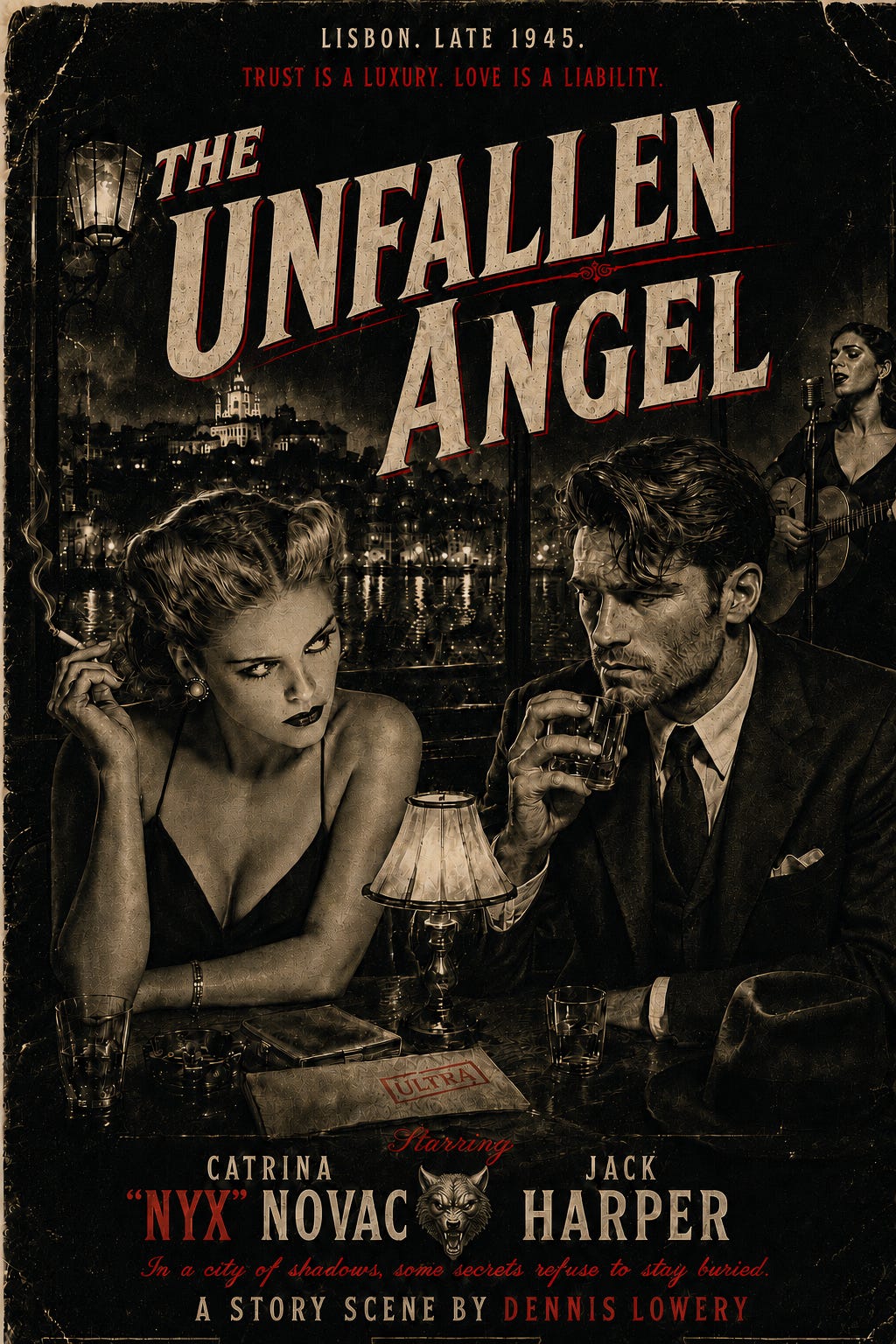
LISBON: LATE 1945
The café faced the Tagus, old bones creaking in the river wind, its windows fogged with the tobacco smoke of men who’d rather not be recognized. Jack Harper sat in the back corner, nursing aguardente he didn’t taste, watching the door out of habit rather than expectation.
He’d been in Lisbon three weeks. Long enough to know which places to avoid, which officials could be bought, and which women were working for which intelligence services. The war was over, but its shadow version, just started, was quietly as hard fought… some had just changed uniforms… and sides.
He’d stayed in Europe. Couldn’t go home yet, maybe ever. Couldn’t explain to anyone what he’d become. The hunger came with the moon now, and he’d learned to cage it, but the cage was made of will, and will eroded.
Somewhere deeper in the café, a fado singer began. Her voice climbed toward grief the way all fado did—slowly, inevitably, as if sorrow were the only destination.
He raised the glass. Stopped.
Across the room, a woman sat alone. Back to the wall. Watching the door without appearing to watch anything.
That stillness. The particular way she held it like a weapon.
No.
He’d written her off as dead. Strada Polonă. The safehouse. Three assets torn apart—the official report said Siguranța, the Romanian secret police. He’d carried that report back to London himself. Her file stamped DECEASED.
But he’d doubted. Even then. Because of what she was. What she’d shown him she could survive.
She turned her head slightly. Not toward him—toward the window. Letting the dim light catch her profile.
She knows I’m here.
Jack’s hand tightened on the glass. The aguardente rippled, caught lamplight. He set it down carefully and crossed the room.
She didn’t look up as he approached. But he saw her register him—a slight tension in her shoulders that relaxed into something worse than fear. Recognition. And beneath it, something like satisfaction.
She wanted me to find her.
He stood over her table. “You a fallen angel....” A statement, not a question. What I called you once. Before I knew.
Catrina—Nyx—returned his stare. Those dark eyes he’d last seen in firelight, reading from Baring-Gould while the screaming started outside the ruined manor walls.
“No.” Her voice hadn’t changed. That slight accent, the precision of someone who’d learned English from books before people. “I got back up.”
And you were never an angel at all.
She gestured to the empty chair. Not an invitation. A command.
He sat. Her cigarette smoke couldn’t quite mask the jasmine. The same scent she’d worn when he first met her in the Hoia Baciu.
The silence stretched. She took a slow drag from her cigarette, didn’t offer him one. Jack shook a Lucky Strike from his pack and pulled his Zippo from a pocket—black-crackle finish, the Ferrets insignia still sharp on its side. He rolled the lighter knuckle to knuckle, a magician’s idle habit, then grip-flick-snapped it to flame. He lit the cigarette, drew smoke, and waited.
“Bucharest,” she said finally. “The safehouse on Strada Polonă.” Flat. Not asking if he remembered.
He did. The report’s typescript. The official stamps. Four dead—three assets, and she was supposed to be the fourth.
“I read the after-action.”
“You read what they wrote.” She tapped ash into a ceramic tray, her eyes never leaving his. “Not the same thing.”
“Then tell me what is.”
That half-smile. The one he remembered from the forest—when she’d pressed the Blood Moon Amulet into his palm and told him the wolves would not know his blood. Before the mirror. Before everything changed.
“Three people died in that house. People with families. People who believed in something.” She met his eyes. “The man who gave up the address? He’s a deputy minister now. Vienna. Doing very well.”
The café noise receded. Glasses clinking. Portuguese murmurs. The fado singer’s voice, still climbing. All of it suddenly distant.
“That wasn’t in any report.”
“No.” She crushed out the cigarette. “It wouldn’t be.”
The question he didn’t want to ask pressed against his teeth. He asked it anyway. “How long have you been watching me?”
“Since you arrived.” No hesitation. No apology. “I needed to know if you were ready.”
“Ready for what?”
“To see me.” She tilted her head, studying him the way she had that night in Romania when she’d asked if he understood what the mirror would cost him. “To face what you’ve become.”
His jaw tightened. The beast stirred—not the hunger, not yet, but something older. Anger. Shame. The particular fury of a man confronting the architect of his damnation.
“You did this to me.”
“I gave you a choice. You made it.” No defensiveness. Simple fact. “The mirror. The incantation. Your hand on the glass, not mine.”
“You knew what it would cost.”
“I told you what it would cost. You decided your team’s lives were worth the price.” She leaned forward, and for a moment, he saw past the feral stillness to something rawer beneath. “Don’t rewrite history, Jack. You wanted to save them. I showed you how. The rest was always yours.”
He wanted to argue. Wanted to tell her about the nights he’d woken with the taste of blood in his mouth, not knowing if he’d dreamed it or done it. The way his reflection sometimes flickered wrong in mirrors. The hunger that climbed with each moon.
Instead, he said nothing. Because she already knew. She’d always known.
She gathered her clutch—small, leather, could hide a derringer or a dossier, certainly her dagger—and stood. He found he couldn’t move to stop her.
“Vienna’s lovely… in spring,” she said. “The deputy minister keeps a regular schedule. If you’re ever curious about what else they wrote.” She paused. “And if you’re ever ready to stop running from what you are... I’m not difficult to find. For someone who knows how to look.”
She walked toward the door. Stopped. Half-turned, the dim light catching her profile again—deliberate, he realized now. Everything about this encounter as choreographed as the operations they’d run together.
“The amulet I gave you.” Her eyes dropped to his chest, where silver hung beneath his shirt. “You’re still wearing it.”
“It’s the only thing keeping me—” He stopped.
“Human?” That half-smile again, edged with something that might have been sorrow. “Oh, Jack. You were never going to stay human. None of us do.” She held his gaze. “The question is what kind of monster you choose to become.”
Then she was through the door and into the Lisbon night, swallowed by fog and the spaces between streetlamps.
Jack sat there a long time. The waiter came. He ordered more aguardente—not whiskey, not American; he wasn’t the man he used to be—and didn’t drink it.
She’d let herself be found. She’d been watching. Waiting. Testing whether he was ready to face her—to face what he’d chosen that night when he’d caught the moon in an ancient mirror and felt something tear loose inside him that would never go back.
He couldn’t do it. Not yet.
The truth of it settled in his chest like cold iron. She was the only one who understood. The only one who could teach him to control it, to use it, to be something other than a man waiting to become a monster.
And he couldn’t follow her. Maybe not ever.
Because following her meant accepting what he was. And he wasn’t ready to stop pretending he might still find his way back.
The singer’s voice finally broke—that moment in every fado when grief becomes too heavy to carry, and the song simply ends. The café fell quiet. Jack stared at the glass he wouldn’t drink and listened to the silence she’d left behind.
Outside, the mist thickened over the Tagus, spilled over the streets into alleys and byways. Somewhere in it, Nyx was already gone—back to whatever shadows she’d emerged from, carrying secrets about burned networks and deputy ministers and the true cost of survival.
She’d offered him answers. A path forward. Maybe even something like absolution.
He’d chosen to stay lost instead.
Some angels fall. Some get back up.
And some aren’t ready to admit they have teeth and claws—that they were never angels at all.
ABOUT THIS STORY
This version will be further edited and may undergo slight changes as it’s integrated into the larger stories it connects to.
“The Unfallen Angel” is set thirty years before the events of The Best Halloween The Town Ever Had, where an aging Jack Harper reveals his haunted past to a young journalist named Rita Zook. This Lisbon encounter—the first time Jack sees Nyx alive after believing her dead—explains why he spent three decades hiding from what he’d become, and why he finally goes looking for her in 1976.
Both stories connect to OPERATION: UNDEAD, the novel-length account of Jack’s OSS mission in Romania (October–November 1943), where he first met Catrina “Nyx” Novac in the Hoia Baciu forest—and where everything changed. Here’s an excerpt from that story, THE SECOND BREATH
And see three of the characters at: Jack | John | Catrina