
TOO MUCH SKY
One song came from inside him. The other came from someone's playlist. Both knew how to taunt him.

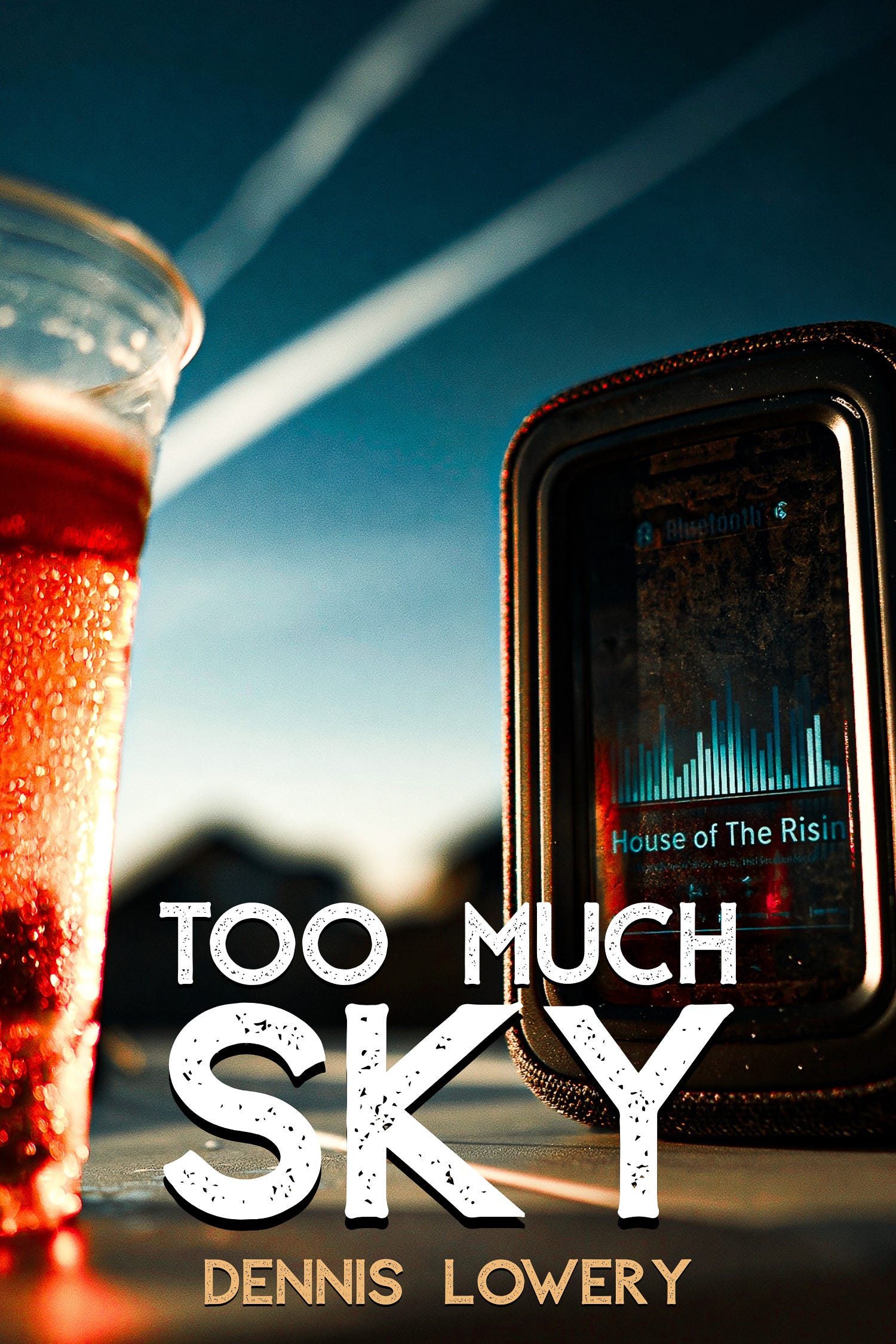
The backyard had too much sky.
Henry Dole sat on the edge of the patio in a white plastic chair that gave a quarter-inch under his weight and then held. The sky above, blue in a way he had forgotten blue. A jet moved through it… slow and soundless. Its white line drawing itself. Over the left side fence, the top of the one tree—a pecan—he could name, moved in a wind he couldn’t feel down here. He took the wind on faith.
Down here was a propane grill in silver and black, hissing low. The smell of charcoal, absent.
Down here was a bouncy castle shaped like a pink cake, a child-sized rental that breathed in and out on its own motor.
Down here were nineteen or twenty people he mostly did not know, arranged in loose clusters on fresh-mowed Bermuda grass.
A woman twelve feet over had a plastic cup of wine the size of a small fishbowl. Near her, two men in Texas Rangers caps were talking about a truck, not the kind of truck men Henry used to know talked about. Everyone had a phone in their hand, somewhere on or near their body. Flat black rectangles that did not ring. They sang.
It all made him think of nothing he had grown up with.
It all made him think of the last thirty-three years.
It made him think of the last eleven days. Since he got out.
The trick, he had learned inside, the first morning and practiced every day until eleven days ago, was to sit or stand where he could see a way out without looking like he was looking at the exits. Cause if you looked that way, it meant you were scared. Henry had learned frightened men have a tough row to hoe.
He did it now. Side yard gate. Patio door. Sliding glass into the kitchen. Three ways. He had counted them when he arrived. His body had paid when he’d been wrong or too slow and didn’t have an out. He knew where ‘out’ was.
Across the yard, his son Wade stood at the grill with tongs in one hand and a spatula in the other, talking to the first Rangers cap. Wade was forty-one years old. Henry had to do the math every time he looked at him because the boy in his head was eight, and Henry, grilling thirty-three years ago, had been forty-one.
Wade—the son of a too loud, too proud man—had been a quiet boy. A boy who could sit on the porch steps and watch a lizard do nothing for an hour. The man at the grill was never still. Always doing something—turning a burger, adjusting a knob, pointing at something in another man’s hand. Whatever had made that boy still… had come loose.
Without him there to see it go. Wade was eight when…
He did not let himself finish the thought. Eight when. You could think a number, or you could think a when, but not in the same breath. Inside, he’d had a discipline about it. Outside was harder.
Wade’s wife, Sherry, came out of the sliding glass door with a platter of uncooked hot dogs and two bags of buns and set them on the folding table. She wore jeans, a sleeveless denim shirt, and her auburn hair pulled back in a clip. She had been polite to him all day in the way you are to someone your husband has described as family. But you haven’t accepted the premise. She had called him Mr. Dole the first morning and Henry after that, at Wade’s asking. She had not yet called him Dad, Pop, or anything like it, and he didn’t expect her to.
The birthday girl was Macy, eight today, who had Wade’s forehead and Sherry’s mouth. She had looked at Henry once from behind her mother’s leg when he arrived. He had crouched—knees popping, a sound they had not made at forty-one—and said hi. Macy had pressed her face into Sherry’s thigh and kept silent. The part of him that remembered—he hoped had remained—inside read the turned-away face, measured it, and began, before he caught it, to answer. He tamped that down. She was eight. He straightened up and did not try again.
Shelby, the six-year-old middle grandchild, side-eyed past him on the grass. Careful, not unfriendly. How a child goes around a dog they’ve been told is good, but haven’t yet tried to pet.
The youngest was Hunter, four. Hunter had not looked at him once. Not avoidance. Creek water going around a stone, not caring about the stone. The boy had simply not registered that a new adult required attention. Henry had watched him, so much young Wade it shook him. He was in the bouncy castle, rising and falling against the mesh, his laugh-scream coming through the nylon.
That was all right. He was all right. He had told himself on the bus out of Huntsville it—he—would be. He had told himself in the parking lot of the halfway house that it would be all right. He was telling himself now, sitting in a plastic chair in his son’s backyard holding a plastic cup of now lukewarm beer he had poured himself from a pony keg by the grill, that he had time.
On the picnic table, a black speaker, ‘Bluetooth,’ Wade had said when he’d asked where the wires were, played something he did not know. A woman’s voice over drums. The music competed with the bouncy castle motor and lost. It ended. Two beats of silence, the motor filling them. Then a guitar.
Not from the speaker. The guitar from inside him.
He had not called for it. It arrived the way songs did when they had lived in you long enough to come and go without permission. Eric Burdon’s voice, The Animals, ‘67 or thereabouts. The quaver at the front of each line.
When I was young
He had been too when he first heard it. An 8-track in his buddy Terrell’s older brother’s Plymouth Fury with its cracked dash and a tape deck that ate every other tape. The windows down and the summer coming through, and the back left speaker—the only one that worked—tinny and half-distorted. The song was about looking back. Shit. Back then, he hadn’t much to look back on, but plenty he wanted to run from.
The feeling in it, that ache of having been someone and not being that person anymore, had lodged. Henry’s hand, resting on his thigh, went still. The one line in the song that had always found him did again. Sung back to him from the inside.
Pain more painful, laughter much louder
Yes. That one.
Inside, he had felt almost nothing at full volume for a long time. Everything turned down. Grief, rage, hope — a pilot light. To get by. Each day, to get by.
He had not known until he was out that it had a cost, too. The blue of the sky today was more than his chest could hold. A child’s laugh from inside the bouncy castle came at him like a thrown ball. When Macy had looked at him this morning in the kitchen and not smiled, the not-smiling had cut more than it should have. Inside, he’d taken cuts… gave some too. Catching time for that, added to the string, that he had finally run out. But Macy’s was deep. Made him think of the exits.
A phone sang on the picnic table. Three notes rising. A woman with silver hoop earrings picked up the phone. Looked at it. Put it down. Did not answer. The phone stopped by itself.
Henry studied the phone. Used to… you just weren’t able to not answer a phone. A phone ringing meant something. You picked it up. Now a phone sang, and the woman decided whether it was worth the trouble.
The riff in his head faded as he exhaled. Wade looked over from the grill, spatula raised, and nodded at him. Not a smile. A nod. Henry nodded back. Fair exchange for both trying to figure everything the fuck out.
Hunter came out of the bouncy castle, slid down the inflated ramp, and ran toward the cooler. He passed within two feet of Henry’s chair without looking. His sneakers were small enough to fit in Henry’s hand. They had lights in the soles that blinked red-blue-red with each step. Henry watched the lights pulse across the grass.
The boy leaned his whole body into the open cooler and pulled out a juice box. He could not get the straw in. Henry watched him work it, the cellophane wrapper challenging his fingers. The boy looked up—not at Henry, past him, scanning for his mother or any other adult. Henry kept his hands on his thighs. Hunter mastered the plastic wrap, found the straw hole, and got it in himself by jamming it through against his stomach. Juice ran over his fingers. He drank, studying something in the grass at his feet.
On the way back to the castle, he slowed. Not stopping, just the drag of a child’s attention caught by something. He stood at Henry’s elbow for maybe eight seconds. Henry did not move. Did not speak. The boy smelled like sunscreen and grape juice. Then Hunter walked on and climbed back into the castle. With the juice box.
Henry’s hands had not moved from his thighs. He unclenched them slowly, spreading the fingers, pressing the pads into the khakis Wade had bought him. New pants. The size was a guess, and close enough.
The speaker, which had gone quiet, began again.
The first chord went into him before his ears registered it. A body thing. His spine knew the song before his brain did. The organ came in underneath, that low moan, and then the vocal line.
He wondered if God or Fate was thumbing him in the eye… and pissing in his ear.
The Animals again. 1964. Older by three years than the uncalled-for song he’d just dwelled on. It had found him, too, the way it had found every poor boy who’d ever done time.
There is a house in New Orleans
His eyes went to Wade, leaning over to kiss Sherry on the cheek as she laughed, her eyes brown as agate, glinting in the sun. Henry’s right hand, which he had just unclenched, closed again. Not a fist. His fingers drew together as if trying to hold something he was afraid he’d drop.
They call the Rising Sun
The party kept going around the song. Sherry’s sister laughed at something on her phone and showed it to the woman with the wine. The grill lid closed. A child called a name Henry did not catch. The bouncy castle motor cycled, and the pink walls shuddered. None of it changed. The song was background noise to them—something that filled a silence, no different from any before it.
Henry kept his eyes on the back fence. Weathered pine, six feet, the grain grayed. On the other side, a green community recycling dumpster in an alley that ran behind the row of houses. When he’d yard-walked the perimeter, he’d seen its lid half-open, kicked back on the fence top. He’d reached to flip it shut. He knew dumpsters. Knew alleys. Knew fences from the wrong side.
And it’s been the ruin of many a poor boy
Inside him, the song and the memory were one and the same. Not the memory of hearing the song. The memory of being the song. When the money that wasn’t his came fast, and the cuffs came faster, and the last courtroom was like any other except that his mother and Diane, Wade’s mother, sat in the third row. When the sentence was read, he had looked at them, not the judge. His mother met his eyes. Diane had looked at her hands.
And God, I know I’m one
Henry’s breathing was even. He had learned that inside. You did not let the body tell anyone around you what was happening inside you. You breathed like nothing was happening, and eventually nothing was… or close enough that the difference stopped mattering. When the lights went out at ten, the block quieted to coughs and mutters, other noises you’d learned to ignore. They weren’t happening to you. And the ceiling became the only thing in the world.
His jaw worked once. A small thing. The muscle along the hinge flexing and releasing. He swallowed what had come up—not bile, not tears, something between them that had no name.
The song’s interlude came.
Across the yard, Wade’s shoulders changed. It was not much. The tongs in his hand stopped turning the meat.
Wade did not look at him.
The song kept going. The woman with the silver hoops lip-synced the next line without looking up from her phone.
Oh mother, tell your children
Wade handed the tongs to the closest man in the Rangers cap. He said something Henry could not hear. The man nodded and took them, and Wade turned and walked—not fast, not slow, the walk of a man going to check on something ordinary—toward the patio.
Henry watched him come.
Wade stopped five feet from the chair, spatula still in his right hand, a grease spot on the front of his T-shirt shaped like Oklahoma.
“You good, Dad?”
“I am.”
Wade looked at him like you do at someone when you’re deciding whether to believe what they’ve said or what their face is doing. Then he stepped forward and put his left hand, the free one, on Henry’s shoulder. The weight of it settled. Two seconds. Maybe three. Wade squeezed once, let go, and walked back to the grill.
Not to do what I have done
The song on the speaker moved on. Something with a fiddle in it now, a man’s voice, a slower tempo. Henry did not know the song, but he knew the voice for what it was—the country radio his own father had listened to in the last years. The kind of music—new country—they had mostly played where he had been, not so much rock-and-roll.
The party continued.
Henry sat in the plastic chair. Not looking at the sky. Macy had come outside and stood on the far side of the table, one hand on its edge, watching the bouncy castle as if calculating the risk. The motor droned. The pecan leaves moved in a breeze.
Hunter came out of the castle and sat on the inflated ramp with his crushed, empty juice box. The straw came out of his mouth with a laugh. Not directed at anything Henry could see. A four-year-old’s belly laugh at whatever four-year-olds find that splits them open—a bug, a cloud, the feeling of sitting still after bouncing your innards out.
Henry heard it clearly. The motor had cycled down between impacts, and the laugh came across the grass unobstructed. He watched Wade go to the boy, hug him, let him go, his eyes trailing Hunter as he headed back into that castle of pink vinyl and air.
He looked up at the sky.
Then watched his boy… watching his boy.
# # #